Shift Left, Comrade: Why Generating Code Was Never the Revolution
Intro
"Who controls the past controls the future. Who controls the present controls the past."
Orwell wrote that in 1984, about a regime that rewrote history on the fly to keep its grip on power. Not, as far as I know, about software delivery. But I have not been able to shake the sentence since I started watching what AI is doing to the way we build, so bear with me.
There is a phrase everyone in my world has fallen in love with lately: shift left. Move your testing, your security, your quality checks to the left, earlier in the process. Say it in a room full of engineers and everyone nods sagely. Say it anywhere else and it sounds like a call to the barricades. Shift left. Seize the means of production. Comrades, the revolution is here, and this time it writes your unit tests for you.
And like every revolution that ever promised paradise by Tuesday, it is worth asking what actually happens after the storming of the Winter Palace.
Because here is the thing. The revolution is real - AI genuinely has changed what one person can build in an afternoon. But most people are cheering for the wrong part of it. They think the revolution is the code generation. It isn't. It never was. And Orwell, of all people, tells us why.
Let me explain.
The past, the present, and the pipeline
Picture the software development lifecycle laid out left to right. It is just the journey from an idea in someone's head to running software in production.
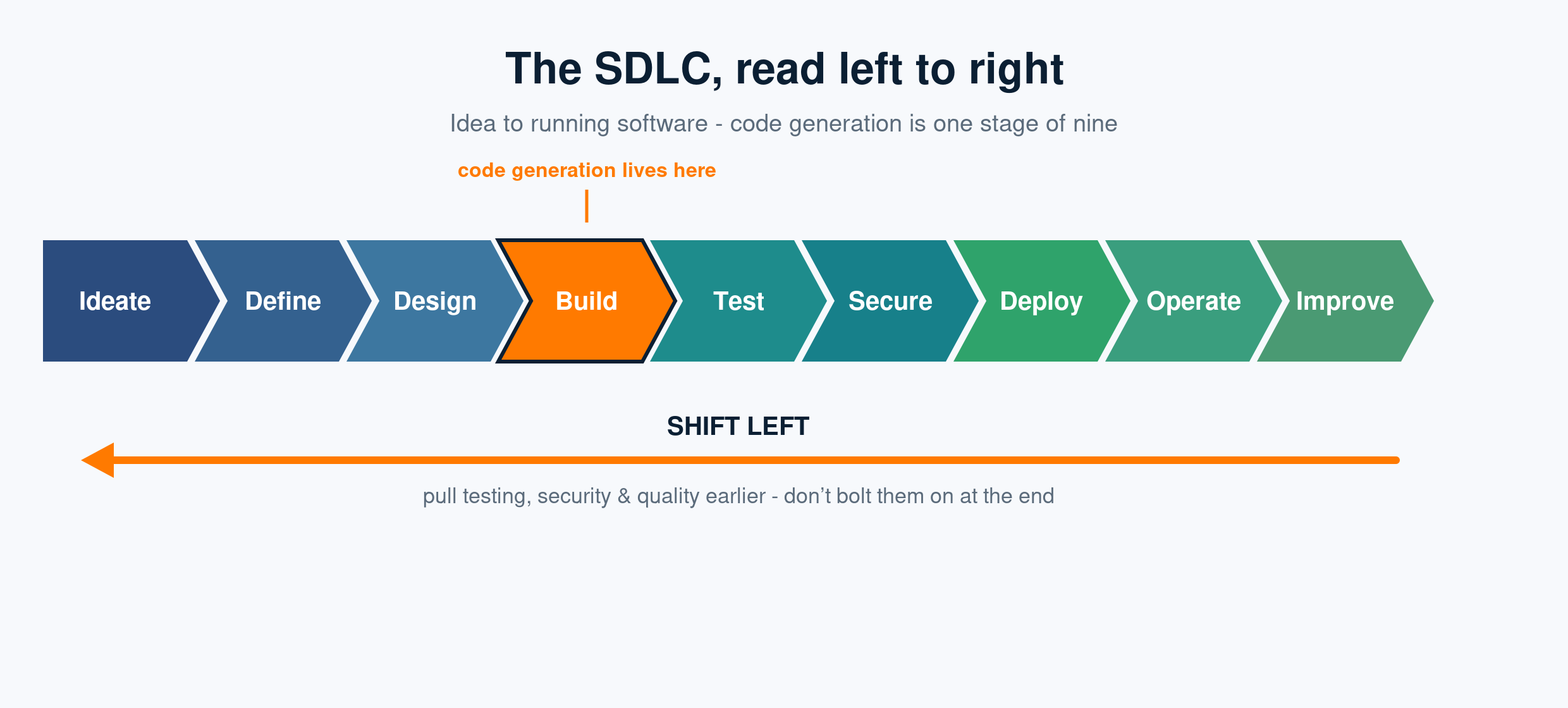
Read left to right, the left is the past and the right is the future. Code generation is one stage out of nine.
Now read the pipeline the way Orwell would.
The left of that flow - Ideate, Define, Design - is the past. It is everything that has to be decided before a single line of code exists. Why are we building this, for whom, and what does "done" actually mean. The right - Deploy, Operate, Improve - is the future. It is the software actually running, in front of real people, doing real work.
Who controls the past controls the future. Whoever owns the left of that pipeline - the requirements, the design, the tests, the security thinking - controls what the future looks like when it finally ships. Get the past right and the future more or less takes care of itself. Get it wrong, and no amount of heroics on the right-hand side will save you. This is the entire argument for shifting left, and it has been true since long before anyone typed a prompt.
But it is the second half of the slogan that should keep you up at night.
Who controls the present controls the past. The decisions you make right now, in this AI-accelerated present, are quietly rewriting the past - the early stages you think you already handled. And that is where the trouble starts. Let me show you what I mean.
The one-line demo trap
A few months back I was in a room full of executives, running through what modern AI tooling can do. You know the setup - laptop plugged into the big screen, expectant faces, someone at the back already half-checking their emails.
I typed a single sentence into the prompt. Something like "build me a customer sign-up page with email validation and store the details in a database." I hit enter, and we all watched the thing write itself. Files appeared. Functions filled in. A minute or so later there was a working sign-up page on the screen, validating emails and everything.
The room lit up. Someone actually clapped. And then the CTO leaned forward, folded his arms, and asked the question I was waiting for:
"Great. So we can ship that on Monday?"
And there it is. That is the trap. Because the honest answer is no - not that page, not on Monday, and not without a lot of work that nobody in that room had just watched happen.
Here is what really went on in that ninety seconds, and it is pure Orwell. I made a decision in the present - one sentence, one keystroke - and the machine reached back and rewrote the past to match it. It invented requirements I never specified. It made design decisions I never approved. It quietly decided what "email validation" meant, how personal data would be stored, what the edge cases were. An entire history of choices that should have been made deliberately, up front, on the left of the pipeline - fabricated in an instant, invisibly, by a tool guessing at my intent.
Nobody voted on any of it. And because it all happened off-screen, everyone in the room assumed the past had been handled properly. It hadn't. It had been overwritten.
That is the one-line demo trap. You type one line, you get working code, and your brain files the job under "done." But generating the code was never the hard part. It was never the expensive part. And it was never the part that keeps software running at two in the morning while you are fast asleep.
The tip of the iceberg
The code you generate is the tip of the iceberg. The ten percent above the waterline. Everyone can see it, everyone claps at it, and everyone underestimates it.
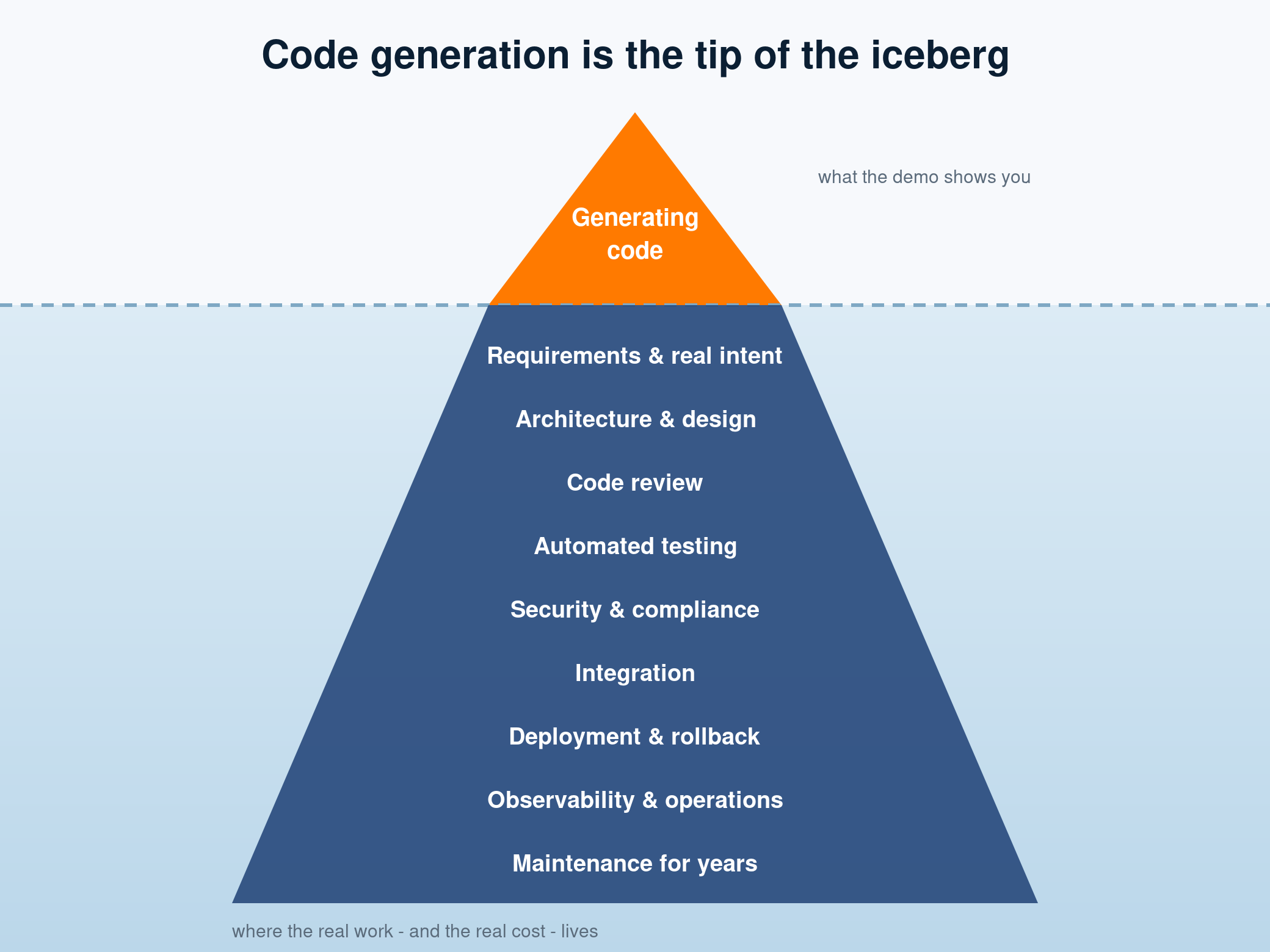
Generating the code is the tip. The real work - and the real cost - lives under the waterline.
Underneath sits everything that actually makes software real - the requirements you didn't quite capture, the architecture that has to hold up under load, the code review, the automated tests, the security and compliance checks, the integration with the seventeen other systems you already run, the deployment, the rollback plan for when it goes wrong, the observability so you can tell when it has gone wrong, and the years of maintenance after that.
None of that appeared on the screen in my demo. It never does. If your whole AI strategy is "generate more code, faster," you have just built a machine for producing more of the cheap bit and none of the expensive bit. You have made the tip of the iceberg bigger. The waterline hasn't moved.
What shift left actually means
So back to the barricades. Strip away the pun and shift left means something very practical: move the things we traditionally do late - testing, security, quality, thinking hard about requirements - as far to the left of that lifecycle as you can. Catch problems while they are still cheap to catch, instead of discovering them in production when they are anything but.
And the reason this is not just process religion is money. Cold, hard money.
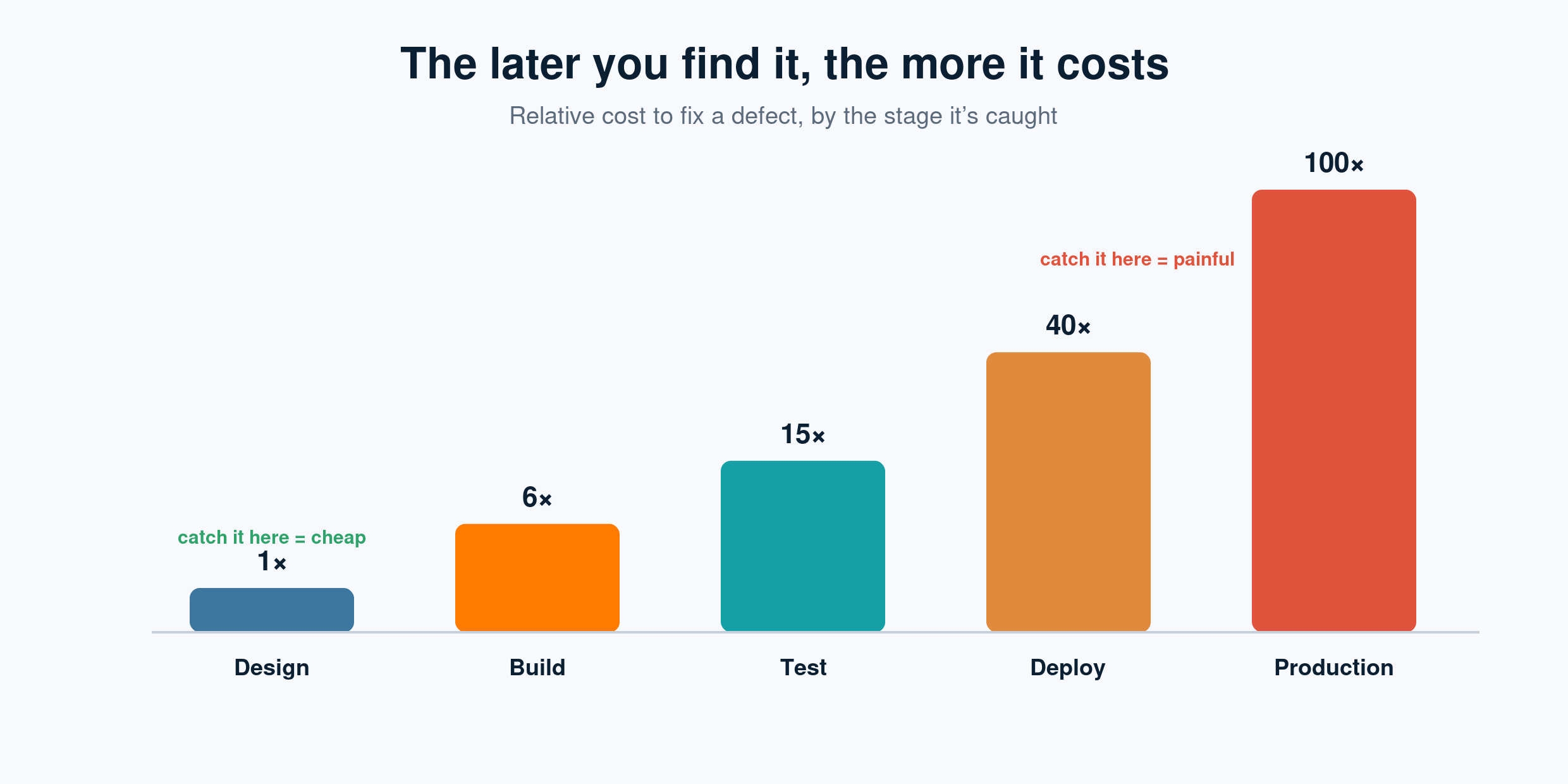
A bug caught at the design stage costs you a conversation. The same bug caught in production can cost you a hundred times more.
A defect you catch while you are still sketching the design costs you a chat and a rethink. The exact same defect, caught in production, costs you an incident, a rollback, some very awkward customer emails, and a scramble to patch it - often at a hundred times the cost. The numbers vary depending on whose study you read, but the shape of the curve never changes. It always goes up, and it always goes up steeply.
So here is the thing that should make you sit up. If you use AI purely to generate more code, faster, without shifting anything left, you are pouring more raw material into the start of a pipeline whose expensive failures all happen at the other end. You are not saving money. You are manufacturing future incidents more efficiently.
Why "just generate the code" quietly fails
Let me tie this back to my CTO and his Monday deadline.
The reason we couldn't ship that sign-up page is not that the code was bad. The code was fine. It was that generating it answered only one of the questions that actually matter, and rewrote every other answer without asking.
Had anyone written down what "email validation" really needed to mean for this business, and the edge cases that come with it? No. Had that page been reviewed by someone who understood our existing systems? No. Was there a single automated test? No. Had security looked at how we were storing personal data, in a world of GDPR and audit trails? Absolutely not. Did it integrate with the CRM, the marketing platform, the identity provider we already run? It had no idea those things existed.
That is the failure mode of code-generation-only thinking. It optimises the one stage that was never really the constraint, and it leaves you with a false sense of doneness. The demo feels like a finish line. It is barely the starting gun.
And it gets worse at scale. When one developer generates ten times more code, the review, testing, security and integration load doesn't stay still - it goes up. The constraint doesn't disappear. It just moves downstream and gets heavier. I have watched teams celebrate their new AI velocity while their code review queue quietly turned into a swamp.
Where the real leverage is
So what do you do about it? You stop thinking of AI as a faster typist and start thinking about the whole lifecycle, left to right.
The teams getting real value out of this are not the ones with the most code-generation seats. They are the ones putting agents to work across the flow - helping to shape requirements at the Define stage, generating and running tests as part of the Build itself, doing a first pass on security review, writing the deployment and rollback steps, watching production and flagging when something drifts. Testing and security stop being a gate you slam into at the end and become something that travels alongside every change. That is shift left, done with agents rather than just good intentions.
The generated code becomes almost a by-product. The value is in wrapping that generation in everything the demo didn't show you - and using the same AI leverage to do that work too, not just the typing.
This, by the way, is why I remain relentlessly optimistic about all of it. Not because AI writes the code - that was always the easy ten percent. But because for the first time we have tooling that can start to chip away at the other ninety percent as well. The requirements, the tests, the reviews, the operability. The bit under the waterline. That is where the years of cost and toil have always lived, and it is finally in scope.
The revolution will not be auto-generated
Every revolution that failed did so the same way. It seized the means of production, declared victory, and forgot that the hard part was never the seizing - it was the unglamorous business of actually running the thing afterwards. The institutions. The plumbing. The boring apparatus that keeps the trains running once the flags have been put away.
The AI code revolution is no different. Generating the code is the easy, cheering part. It is the storming of the Winter Palace. The revolution is not won there. It is won - or lost - in the review, the testing, the security, the governance, the operability. The past you have to get right so the future holds, and the discipline to not let a one-line prompt in the present quietly rewrite it all behind your back.
So shift left, comrade. Genuinely, do. Just remember what Orwell actually understood: whoever controls the past controls the future. In our world, the past is the left of that pipeline - and if you let a machine seize it in a single keystroke and cheer while it does, don't be surprised when the future you get is not the one you were promised.
The winners in this next chapter won't be the ones who generate the most code. They will be the ones who shifted everything else left to meet it.